
Tuesday, February 13, 2018

Thursday, January 5, 2017
10 Anti-Burglary Tips for Sellers
10 Anti-Burglary Tips for Sellers
When your clients are opening their doors to the public for showings, they need to take extra precautions. Share these suggestions to help them keep their belongings safe.

After Christmas, many people put the empty boxes their expensive gifts came in out on the curb. What do you think that says to potential burglars? It screams, “I just got a brand-new TV! Come and rob me!”
That’s just one example of some unwise habits homeowners have. If those owners are sellers opening their doors to the public for showings, habits such as these put them in even greater danger. The above example is a good warning to give to your clients now, since we’re in the holiday season. But use it as a jumping-off point to have a deeper conversation about safety — and to show that your safety knowledge is an asset to sellers.
Consider using this checklist (you can request it as a customer handout on my website) during listing appointments to better prepare prospective sellers and show your value as a real estate professional. We spend a lot of time telling sellers how we’ll market their home, and while that is obviously important, we rarely address their true concern: how to keep their home safe while it’s open to the public. Touch on these 10 anti-burglary tips so your clients will know that you have their best interest at heart.
National Snapshot of BurglariesA burglary is committed every 20 seconds, with nearly 1.6 million such crimes nationwide annually, according to the FBI’s 2015 Crime in the United Statesreport. That’s down 7.8 percent from 2014. Total property crime, which includes arson, larceny theft, and motor vehicle theft, reached nearly 8 million instances in 2015, down 2.6 percent from 2014.
- Maintain your property. Especially in the wintertime, many people stay indoors and neglect issues such as peeling trim or an overgrown yard. But if the home looks unkempt, thieves may think it’s abandoned and, therefore, an easy target. Shoveling your walkways to clear them of snow and debris and removing holiday decorations and fallen tree branches in a timely manner will signal that the home is occupied.
- Know your neighbors. Many people don’t really know their neighbors; it’s more than just saying hi and being friendly. Invite them over to see your home before it goes on the market, and introduce them to the people they may see regularly stopping by during this time (especially your agent). Then they’ll know who is and isn’t supposed to be at your home and can better assess when there may be a threat while you’re gone.
- Assess your home’s vulnerability. Walk to the curb and face your house. Ask yourself, “How would I get in if I were locked out?” The first thing you think of, whether it’s the window with a broken lock or the door that won’t shut all the way, is exactly how a thief will get in. Think like a burglar, and then address the issues that come to mind.
- Respect the power of lighting. Criminals are cowards, and they don’t want to be seen. The house that is well-lit at night provides a deterrent because thieves don’t want the attention and the potential to be caught by witnesses. It’s wise to invest in tools that make nighttime light automation easy. That includes dusk-to-dawn adapters that go into existing light fixtures and motion detectors. But beware of leaving your exterior lights on at all times, which signifies the occupant is gone for an extended period of time.
- Use technology to make your home look occupied. In addition to lighting, smart-home technology has made it easier to make it appear like people are home, even when they’re not. Systems that remotely control lighting, music, and appliances such as a thermostat can help you achieve this. Though not considered smart-home tech, simple lamp timing devices available at hardware stores are also good for this purpose.
- Yes, it has to be said: Lock your doors. It’s amazing how many people think they live in a safe-enough neighborhood not to have to lock their doors when they leave. Some facts sellers should know: In 30 percent of burglaries, the criminals access the home through an unlocked door or window; 34 percent of burglars use the front door to get inside; and 22 percent use the back door, according to the FBI Uniform Crime Report.
- Reinforce your locks. A good door lock is nothing without a solid frame. Invest in a solid door jam and strike plate first, and then invest in good locks. Know the difference between a single-cylinder and a double-cylinder deadbolt. Double-cylinder deadbolts are recommended because they require a key to get in and out. For safety and emergency escape purposes, you must leave the key in when you are home. But double-cylinder locks are against regulations in some places, so check with your local police department’s crime prevention office.
- Blare the sirens. Burglars are usually in and out in less than five minutes, and they know police can’t respond to an alarm that quickly. Their bigger concern is witnesses to their crime. For that reason, an external siren is invaluable, whether as part of a monitored security system or a DIY alarm. Even if you don’t have an alarm, it’s not a bad idea to invest in fake security signs and post them near doors.
- Consider surveillance cameras. The Los Angeles Police Department started a program encouraging homeowners to install a device called Ring, a doorbell with video surveillance capability that allows homeowners to view what’s outside their door on their smartphone, in a neighborhood that was a target for burglaries. After Ring was installed in hundreds of homes, the burglary rate dropped by 55 percent, according to reports. Most state and local regulations require posting a warning that people are being recorded. (But again, this can be effective even if you don’t actually have the cameras installed!)
- Mark your valuables and record details. Use invisible-ink pens or engravers to mark identifying information (driver’s license or state ID numbers) on items. Log serial numbers and take photos of your belongings. Check to see if your police department participates in the Operation Identification program. They will have stickers for you to place on doors or windows warning would-be thieves that your items are marked. These steps may prevent them from pawning or selling stolen items and can help you reclaim recovered belongings.
Thursday, February 18, 2016
Help with Saving for a Downpayment
Saving for a down payment is a challenge for
many first-time buyers. If this sounds like you or someone you know, it might
be time to change your habits. The information below offer tips to help you
change your habits and save more money.

Wednesday, January 27, 2016
Garage Organization Ideas for Under $50
Garage Organization Ideas for Under $50
If clutter trumps cars in your garage, get organized (and make room for your vehicles) with these smart garage storage solutions, each costing less than $50.

View Photo Gallery
1 of 5
Bikes, Skates, and Other Wheels
Bicycles, skateboards, scooters, and rollerblades — wheeled belongings can get underfoot and land you on your assets or bang up the car. Protect your paint job (not to mention your backside) with these wily storage solutions for your garage.
Bicycles, skateboards, scooters, and rollerblades — wheeled belongings can get underfoot and land you on your assets or bang up the car. Protect your paint job (not to mention your backside) with these wily storage solutions for your garage.
- Hoist bicycles to the rafters with a rope-and-pulley system (starting around $40) that makes it easy to raise the bike and lock safely in place. When you’re ready to ride, release the lock and lower your bike to the garage floor. You’ll need an hour or two and basic tools to secure the pair of pulleys to ceiling joists and thread the ropes. (Similar hoists are available for kayaks or small boats; starting around $25.)
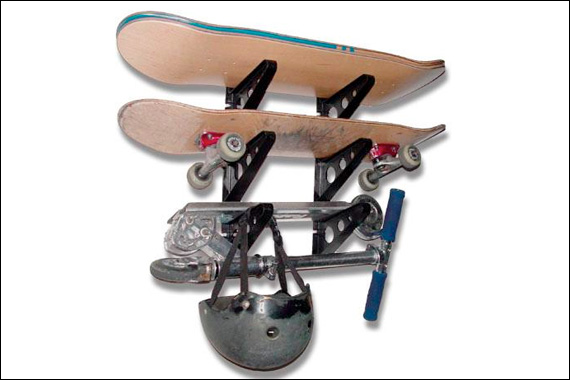
- Avoid unintentional skateboard “tricks” with a specially designed wall rack that makes it easy for kids to hang up helmets and skateboards together; starting around $20. Secure this one to wall joists in less than an hour.
- Keep scooters and bikes out of the way with tool hooks installed on a length of 1-by-6-inch lumber. You’ll pay $3 for each pair of vinyl-coated screw-in tool hooks and $1 per foot for lumber. You’ll need only an hour or two to secure the lumber to wall joists and screw the hooks into place along the board.
Sporting Goods
Active pursuits require a lot of gear that ends up in the garage. These organizers help tidy up all those sports balls, rackets, bats, gloves, clubs, fishing rods, and other outdoor fun-related goodies.
Active pursuits require a lot of gear that ends up in the garage. These organizers help tidy up all those sports balls, rackets, bats, gloves, clubs, fishing rods, and other outdoor fun-related goodies.
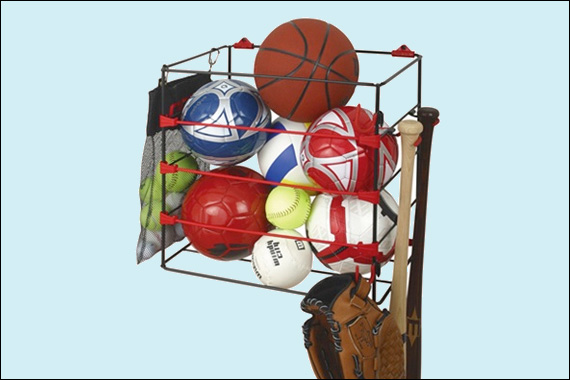
- Bring together balls and bats on a convenient wire rack equipped with hangers that hold gloves too; starting around $35.
- To keep your garage organization from going downhill, stash two pairs of snow skis, poles, and boots in one handy steel ski rack; $45. Securing this rack to wall studs helps it hold the weight of the equipment. If you can’t position it on studs, use wall anchors for a secure installation. You can do the task with or without anchors in an hour or two.
- Make a port for your fishing rods by suspending two wire shelves from your garage ceiling about 5 feet apart, then threading the rods through the openings. Use shelves left over from a project or purchase a 4-foot-by-16-inch vinyl-coated wire shelf for less than $9, and saw it in half crosswise (or clip with bolt cutters) to make two 2-foot shelves. Snip additional wires where you need wider slots to accept pole handles or reels.
Tools
With a little imagination, you won’t need specially designed storage to organize your tools.
With a little imagination, you won’t need specially designed storage to organize your tools.
- Conveniently hang wrenches and bungee cords using an ordinary vinyl-coated wire tie-and-belt rack, available at big box stores; $8.
- Metal tools cling to a magnetized rail, keeping items in view and easy to retrieve; starting around $30. Simply screw the rail to wall studs to safely hold the weight of the tools (it’s an idea you may be drawn to.)
- Cushion and protect tools by padding your toolbox drawers with a soft, non-slip liner. The open-weave design keeps moisture away and prevents tools from rolling around. Enough material to line eight average-size drawers is $15. Just cut the liner to length to fit and slip it into the drawer.
- Organize small items — such as pencils, box cutters, and tape measures — by stashing them in electrical junction boxes; about $2 each (free if you have spares). Purchase a variety of sizes and shapes and secure them to studs or pegboard.
Yard and Garden Gear
Rakes, ladders, clippers, shovels, and sprays — a host of supplies keep your yard and garden looking lush and well-cared-for, but your garage? Not so much. Keep your garden and landscaping tools organized with these novel storage solutions.
Rakes, ladders, clippers, shovels, and sprays — a host of supplies keep your yard and garden looking lush and well-cared-for, but your garage? Not so much. Keep your garden and landscaping tools organized with these novel storage solutions.
- Transform an old cabinet into a nifty garage storage unit on wheels. Hunt down an old four-drawer filing cabinet for a few dollars at a garage sale. Remove the drawers, turn it on its backside, and use a couple afternoons to apply paint and pegboard sides. Less than $25.
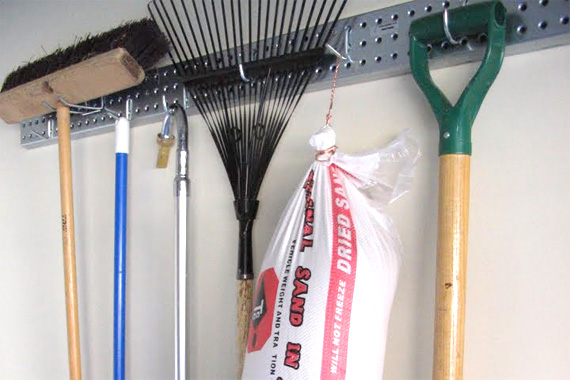
- Hold heavy tools, long-handled implements, ladders, and more. Long steel rails with extruded holes mount high on the garage wall and secure to studs. Arrange a series of hooks and pegs on the rail to hang big tools. Two 48-inch rails sell for $22.
- Secure a wooden pallet to wall studs to create a pocket for holding long-handled garden tools. To find free wooden pallets, check with local businesses as well as online classifieds, such as Craigslist. Cost: Free.
- Keep bottles of fertilizers, repellants, and lubricants upright and easy to retrieve. A can rack ($15) prevents cans and bottles from tumbling off shelves.
Related: See a slideshow of more garage storage ideas.
 Jan Soults Walker
Nationally published home improvement writer Jan Soults Walker and her husband, Dave, once built a window seat with flanking bookcases into a kitchen. It remains one of their favorite storage projects to date.
Read more: http://www.houselogic.com/home-advice/garages/garage-organizers/#ixzz3yTTdGdwe
Follow us: @HouseLogic on Twitter | HouseLogic on Facebook
Thursday, January 7, 2016

Wednesday, December 16, 2015

Tuesday, May 5, 2015

Monday, June 9, 2014

Wednesday, October 2, 2013

Tuesday, August 13, 2013
Big Cat Poker Run ROARS into East County!

The Discovery Bay Big Cat Poker Run comes to town Aug. 16 and 17. The fundraising event is hosted by the Discovery Bay Lions Club and supported by local businesses and organizations.
“We’re looking forward to another great event,” said Lion Jim Mattison. “People love to come because it’s on the Delta. How can you lose?”
The weekend fun begins Friday, Aug. 16 with a lunch run that leads boaters on a tour of the Delta. A welcoming party and registration event follows that evening. Saturday is the Poker Run with stops at Pittsburg and Stockton, allowing plenty of time to socialize, and it’s followed by a poker draw and party at the Discovery Bay Yacht Harbor that evening. The public is invited to attend.
The event can also be experienced on land. Everyone can anchor at the mouth of Indian Slough to watch more than 90 boats blast off on Saturday at 9 a.m.
The boater entry fee is $150 per person in advance; $175 per person at the event. Price includes one poker hand, event T-shirt and hat; Friday evening party; and Saturday poker run, breakfast, lunch and dinner at the Discovery Bay Yacht Harbor.
For details and registration or sponsor information, visit www.bigcatpokerrun.com.
Read more: thepress.net - Big Cats roar into Discovery Bay
Wednesday, July 3, 2013

Monday, June 10, 2013
Extend the Outdoor Living Season
Extend the Outdoor Living Season
Make an outdoor living area comfy long after the sun sets or the leaves turn with outdoor lighting, a patio heater, and a glowing firepit or portable fireplace.
With both lighting types, you can:
- Light deck railings and stairs
- Define the patio perimeter
- Illuminate the edges of paths and walkways
- Draw attention to a planter or tree
Other fixtures light up dining tables, grill surfaces, and even underwater in swimming pools.
Low-voltage fixtures clip onto a safe, 12-volt cable connected to a transformer, which plugs into a GFCI-protected 120-volt electrical outlet. A timer or light-sensitive control automatically turns lights on and off.
A low-voltage lighting kit with eight LED stainless steel fixtures, 50 feet of cable, and a transformer starts at $60. Individual low-voltage fixtures range in price from $7 for a simple poly-resin fixture up to about $150 for architectural-grade, cast-brass models.
Solar outdoor lighting fixtures don’t need cables and transformers. They simply turn themselves on automatically after dark. Each stand-alone fixture stakes into the ground or secures to a deck or exterior surface. You’ll save energy, as a sunlight-charged battery powers the bulb.
The downside to solar fixtures is a dimmer glow than low-voltage fixtures, and fewer lighting hours – many solar fixtures run out of stored energy after 4-5 hours on the job. Cloudy days also reduce power.
A four-pack of solar light fixtures that mount on top of deck posts starts at about $30. Or, check out a cast-aluminum solar lantern for about $60.
Low-voltage fixtures clip onto a safe, 12-volt cable connected to a transformer, which plugs into a GFCI-protected 120-volt electrical outlet. A timer or light-sensitive control automatically turns lights on and off.
A low-voltage lighting kit with eight LED stainless steel fixtures, 50 feet of cable, and a transformer starts at $60. Individual low-voltage fixtures range in price from $7 for a simple poly-resin fixture up to about $150 for architectural-grade, cast-brass models.
Solar outdoor lighting fixtures don’t need cables and transformers. They simply turn themselves on automatically after dark. Each stand-alone fixture stakes into the ground or secures to a deck or exterior surface. You’ll save energy, as a sunlight-charged battery powers the bulb.
The downside to solar fixtures is a dimmer glow than low-voltage fixtures, and fewer lighting hours – many solar fixtures run out of stored energy after 4-5 hours on the job. Cloudy days also reduce power.
A four-pack of solar light fixtures that mount on top of deck posts starts at about $30. Or, check out a cast-aluminum solar lantern for about $60.
Get glowing with a firepit or portable fireplace
Bring a cozy glow and a stylish focal point to your outdoor living area with a firepit or portable fireplace. Irresistible for gathering, warming up, and roasting marshmallows, firepits and portable fireplaces come in a variety of materials, sizes, and styles. You’ll also find options for fueling your fire with wood, propane, gas, or gel cans.
Check local fire codes first to find out if your community allows the use of a firepit or portable fireplace on the patio or lawn. (Never use a fire feature on a wood deck.)
A firepit ($100-$500) is an open bowl, dish, or pan that varies in size from 24 inches across to about 40 inches. A firepit may come on a stand (some with wheels) or nestle into a tiled tabletop. Select a model with screening to contain flyaway sparks.
A portable fireplace ($100-$600) features a chimney to vent smoke up and away from people. Some portable fireplaces offer 360-degree views of the fire.
Check local fire codes first to find out if your community allows the use of a firepit or portable fireplace on the patio or lawn. (Never use a fire feature on a wood deck.)
A firepit ($100-$500) is an open bowl, dish, or pan that varies in size from 24 inches across to about 40 inches. A firepit may come on a stand (some with wheels) or nestle into a tiled tabletop. Select a model with screening to contain flyaway sparks.
A portable fireplace ($100-$600) features a chimney to vent smoke up and away from people. Some portable fireplaces offer 360-degree views of the fire.
Warm up with a patio heater
Boost the warmth of your outdoor living area by as much as 15-25 degrees in the fall or spring with the addition of a portable patio heater. You’ll find three basic models:
- Freestanding units resemble large floor lamps. Set them anywhere on your patio that will accommodates their 7-8 foot height. Some models include wheels for mobility. Expect to pay from $150 to $1,500, depending on heat output and fuel source.
- A tabletop patio heater rests on a table, bench, or garden wall. These compact units typically produce less heat than tall, freestanding models. Prices range from $100 to $450.
- Ceiling- or wall-mount patio heaters free up floor and table space, and typically emit heat via a halogen lamp. Prices vary from $175 to $1,500.
Make your selection based on how much outdoor living area you want to heat and whether you want a model powered by electricity or natural gas (each requiring a connection) or with a propane tank, which allows mobility.
As a rule of thumb, a 47,000 BTU propane-powered, floor-standing patio heater ($200) will heat an 18-foot diameter space. A 20-pound propane tank (about $36, plus $13 for fuel) offers about 10 hours of heating time.
Electric patio heaters use a quartz tube or halogen lamp that emits radiant heat. An infrared wall-mount electric patio heater ($450) equipped with a 1500-watt bulb heats a 9-foot area around the heater and uses about 14.4 kilowatts for a 10 hour period. At 8 cents per kilowatt for electricity, you spend about $1.15 to operate the unit for 10 hours.
As a rule of thumb, a 47,000 BTU propane-powered, floor-standing patio heater ($200) will heat an 18-foot diameter space. A 20-pound propane tank (about $36, plus $13 for fuel) offers about 10 hours of heating time.
Electric patio heaters use a quartz tube or halogen lamp that emits radiant heat. An infrared wall-mount electric patio heater ($450) equipped with a 1500-watt bulb heats a 9-foot area around the heater and uses about 14.4 kilowatts for a 10 hour period. At 8 cents per kilowatt for electricity, you spend about $1.15 to operate the unit for 10 hours.
Subscribe to:
Posts (Atom)